
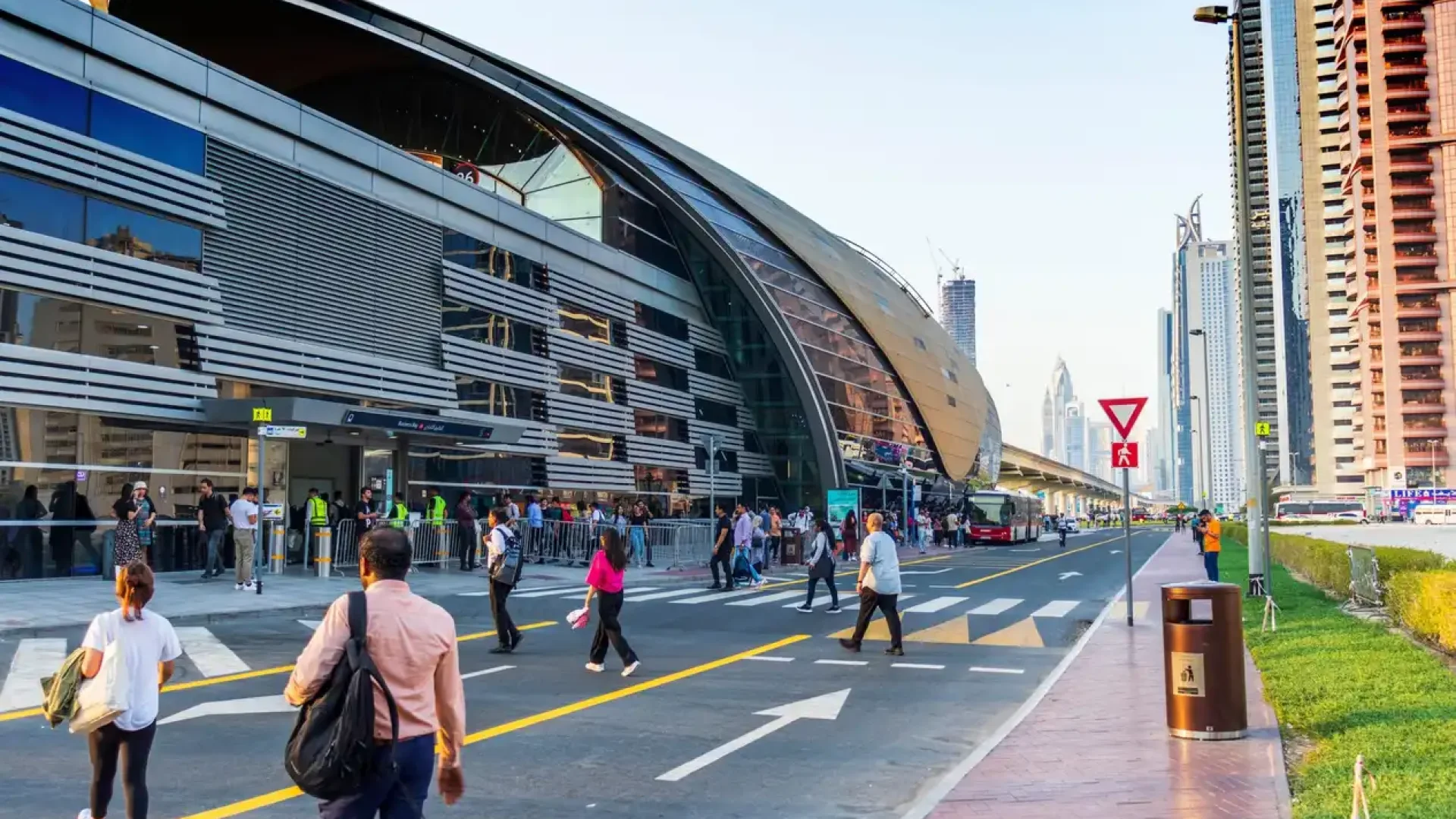

Dubai doesn’t just build transport; it builds momentum. The proposed “Gold Line” metro, still at the planning and expectation stage, is already reshaping how buyers and tenants talk about location—because in this city, minutes saved can translate into money earned. Analysts and brokers anticipate that properties within walking distance of future stations could command stronger rents and higher sale prices, echoing patterns seen around existing metro corridors. For investors, the opportunity is as much about timing as it is about geography: getting in before the tracks turn into a premium line on every listing.
The heat has that late-morning shimmer, the kind that makes distant towers look like they’re floating. A security guard leans against a temporary fence, watching cars roll in and out of a site that is, for now, more promise than place. On a billboard above him, a sleek line cuts across a stylized map of Dubai. “Gold Line,” it says, as if two words could tilt a city.
In Dubai, they often can.
Because a metro line here isn’t just a way to move people. It’s a way to move value. A new corridor changes commutes, then habits, then the pecking order of neighborhoods. And that’s why the proposed Gold Line—a future addition to Dubai’s metro network highlighted in recent market analysis—is already stirring the property conversation. Not with the slow patience of infrastructure elsewhere, but with the quick, speculative electricity that Dubai does so well.
Ask any renter stepping out of a lobby at 8:10 a.m. what they want, and you’ll hear it in different accents but the same meaning: less time in traffic. In a city that keeps stretching outward and upward, proximity to rapid transit becomes a form of daily relief. That relief has a price tag.
Market watchers expect that homes and apartments within walking distance of Gold Line stations—once the route and stops are finalized and delivered—could see stronger demand, firmer rents, and better resale performance. The logic is familiar from other global cities, but in Dubai it’s amplified by speed: new communities rise quickly, and perceptions can change even faster.
A broker in a glossy sales center puts it bluntly, tapping a map on the table: “People don’t buy a district. They buy a commute.” Then, softer: “And they pay more when the commute is certain.”
Dubai’s existing metro corridors offer a kind of urban lesson. Areas that were once described as “a bit out” became “well connected.” Towers that competed on pools and marble finishes began competing on something more measurable: distance to the station door.
That’s the story investors are now attaching to the Gold Line. Not because rails automatically guarantee profits, but because connectivity is a durable driver. It affects tenant pools, reduces vacancy risk, and widens the buyer audience at exit. When the city signals that a location will be plugged into the network, developers follow with launches, retail follows with leases, and residents follow with routines.
One of Dubai’s most distinctive property traits is how early the market prices in a narrative. The lift doesn’t necessarily wait for the ribbon-cutting. It can begin with confirmation, renderings, route chatter—anything that makes the future feel tangible.
That’s why timing matters. Buyers who move early are often buying into expectation value: the belief that when the station is real, the address will read differently. But expectation is a double-edged thing. If supply floods in at the same time—too many similar towers, too many launches—rents can plateau even as the location improves.
So the smart question isn’t simply, “Is it near the metro?” It’s, “How near, in real life?” Not a pin-drop distance on a map, but a walk in July. Shade, crossings, footpaths, entry points, noise, privacy—these details decide whether a ‘metro-adjacent’ home feels like a convenience or a compromise.
In one showroom, a family stands over a scale model: tiny towers, tiny roads, tiny palm trees. The sales agent draws a finger along a thin line. “New metro,” he says, like he’s offering a shortcut through the future.
The father leans in. “How long to downtown?”
“Faster,” the agent replies, smiling, because numbers can change but the promise stays the same.
The mother doesn’t ask about the pool. She asks about schools, the supermarket, the walking route. The agent nods. “It will all come,” he says—another very Dubai sentence, equal parts confidence and construction schedule.
This is how infrastructure becomes emotion. And once it becomes emotion, it becomes demand.
The Gold Line’s impact won’t be uniform. Typically, the biggest price and rent sensitivity shows up in:
Meanwhile, areas already saturated with premium stock may see a more modest uplift, especially if they’re competing with newer product delivered right on top of a station.
For real estate investors, the proposed Gold Line is best understood as a connectivity catalyst—one that can improve liquidity at resale and strengthen rental defensiveness, provided the asset selection is precise.
The clearest implication: if the Gold Line proceeds as expected, it may not just shift commutes—it may shift which addresses feel inevitable. In Dubai, inevitability is expensive. And investors who recognise the map before it becomes common knowledge are often the ones who capture the premium when the rails finally turn from concept to cadence.